Who pays for a verified dispense, how drugs are screened, and the markets beyond the pharmacy bottle.
01
Drug selection
01.1
Drug Group Framework: Segment, Qualify, Prioritise
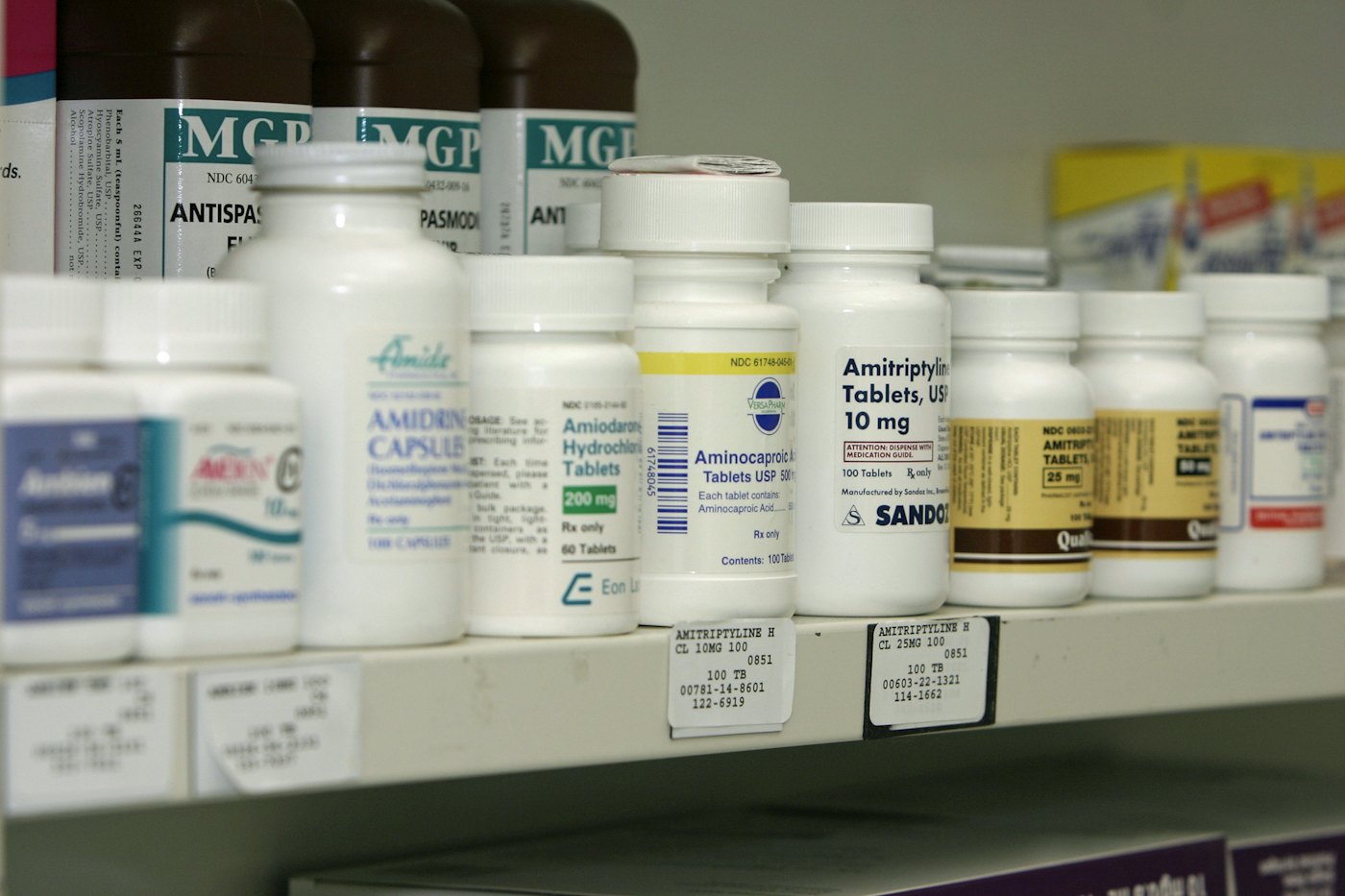
Stock photo
A Repeatable Screen, Not a Fixed List: 24 Drugs to 28
Three stages — what a missed dose costs, four mechanical gates, then whether it is worth tooling.
1
Stage 1 · Segment
By what a missed dose costs, and who therefore pays: A therapy loss (pharma first), B acute event (pharma on patent, plan once generic), C aggregate cost (plan-funded).
2
Stage 2 · Qualify — four gates, all must pass
Form: a tablet, or a non-gelatin capsule. Container: the patient receives the maker's bottle, not a blister wallet. Geometry: one opening size and one shape as the patient titrates and across suppliers. Regimen: chronic or cyclic with a defined plan — not PRN, not split tablets.
3
Stage 3 · Prioritise
A qualified drug is not automatically worth tooling: avoided cost per patient-year, patients on the molecule, who funds and for how long, moulds × sizes, and who signs.
U.S. patient counts: ClinCalc DrugStats (MEPS 2023) where listed, else Coledy sizing. Packaging: FDA NDC Directory. Shape and size: DailyMed. Running the gates is what removed four widely-prescribed specialty drugs from an earlier version of the tables that follow.
01.2
A Dose Is Not Always One Tablet
All 28 regimens read off FDA labelling — and the three things it changed.
Tablets per dose × doses a day, across the 28 therapies
1 tablet × once a day17 · 61%
1 tablet × twice a day5 · 18%
4 tablets × once a day3 · 11%
2 tablets × twice a day2 · 7%
Mixed strengths × once1 · 4%
Simultaneous — served
Several strengths at once, each bottle stable: one device per strength, each sensed and scored on its own, both in one app. Envarsus XR 0.75 / 1 / 4 mg · Lynparza 150 + 100 mg.
Sequential — out
One bottle whose tablet changes shape as the patient titrates. No number of devices fixes it. Jakafi round → oval → capsule · Cabometyx round → triangle → oval.
What the audit did not change twenty-one once-daily and seven twice-daily, confirmed against all 28 labels — the split already published, so no figure moved. What it did change the geometry gate now routes a split dose to a device per bottle instead of rejecting it, and pPDC caps per bottle.
What has not been measured: a four-tablet dose is four separate tilt-and-release actions. Field use so far has been on one-tablet regimens, so whether patience holds across four tilts is untested on five of the highest-value rows.
Regimen is tablets per dose × doses per day, read off FDA labelling for all 28 rows; shares round to 101%. Loading and ramp-up doses are named separately — Brilinta and Plavix load at two and four tablets, Eliquis opens DVT/PE at two, Venclexta ramps on a wallet.
01.3
The Screen Rejects More Than It Accepts
Every gate is run against FDA labelling — here is what failed, and the line that failed it. A list of drugs is a claim; a list of what failed and why is a method.
Out on geometry — the patient crosses shapes
Jakafi: starts at 10 mg twice daily and titrates in 5 mg steps — three shapes in normal use
Cabometyx: 60 → 40 → 20 mg reduction is routine, and 40 mg is a triangle
Xarelto: the DVT / PE course switches 15 mg to 20 mg and starts on a blister
Out on packaging — no bottle to sit on
Trikafta: co-packaged blister wallet
Ibrance: monthly box of weekly blisters
Imbruvica: folded blister cards
Verzenio: stored in the original blister
Out on shell — gelatin goes tacky
Revlimid · Gilenya · Tecfidera · Hydrea — the exclusion is the shell, not the shape
Kept, with the limit named
Venclexta: maintenance only — the four-week ramp-up is a wallet
Tagrisso: 80 mg oval, but 40 mg round on dose reduction
Keppra: all strengths are scored, so a half tablet is available
Four of five permanent exclusions fail on form or regimen, not geometry. Geometry decides among generics — and there it is usually recoverable, because what fails is that suppliers disagree on shape. The same lines that reject a molecule are the spec a partner can design to.
02
Target drugs
02.1
28 Priority Therapies, Three Groups
Six therapeutic areas, three entry groups — nine, eleven and eight drugs, screened from U.S. prescription data.
Drugs by therapeutic area
Oncology8
Cardiovascular7
CNS & psychiatry6
Infectious disease3
Immunology & transplant2
Metabolic & diabetes2
Group
What a failure costs
U.S. patients
Areas
A · Therapy loss
A therapy forfeited to resistance
~0.83M
Oncology · HIV · PAH
B · Acute event
Relapse and crisis
~3.2M
CNS · oncology · transplant
C · Aggregate cost
Small per patient, enormous in total
~51.4M
Cardiovascular · metabolic
A · Therapy loss — the manufacturer holds it
Oncology, HIV, pulmonary arterial hypertension. A missed dose costs the therapy itself. The payer buys these drugs at $48,000–$200,000 a patient-year, but a day never dispensed is a day never sold — so the maker carries the loss.
B · Acute event — the payer, twice
CNS and psychiatry, transplant, cardiology. A missed dose becomes an event — a relapse, a rejection, an admission. The payer buys the drug and then the admission that follows.
C · Aggregate cost — the payer, and it is scored
Statins, RAS antagonists, oral diabetes agents. No single missed dose matters; the accumulation does. Cheap generics, yet the payer still loses — all three triple-weighted Medicare adherence measures sit here.
Two funding routes, never zero: a manufacturer whose therapy is lost when a dose is missed, or a payer already scored on the measure. A drug with neither is not on this list — that is what the screen tests for, and why the list is 28 and not 2,800.
Counted per drug — a patient treated for three of these appears three times, and carries three devices. Source: ClinCalc, CDC, FDA.
02.2
Group A — Therapy Loss
High-cost therapies where a missed dose lets resistance or progression in. ~0.83M U.S. patients.
Drug
Indication
U.S. patients
Drug cost / yr
What a missed dose does
Biktarvy
HIV-1
430K
$48,000
Resistance mutations emerge
Dovato
HIV-1
180K
$45,000
Two drugs, less margin for error
Xtandi
Prostate cancer
55K
$200,000
Androgen blockade lapses
Nubeqa
Prostate cancer
25K
$130,000
Androgen blockade lapses
Erleada
Prostate cancer
30K
$140,000
Androgen blockade lapses
Lynparza
Ovarian & breast cancer
35K
$180,000
Maintenance window closes
Venclexta
CLL & AML
30K
$160,000
Remission depth erodes
Tagrisso
Non-small-cell lung cancer
30K
$165,000
EGFR resistance emerges
Opsumit
Pulmonary arterial hypertension
12K
$175,000
Clinical worsening, then escalation
Why Xtandi is the only branded addition
The 40 mg film-coated tablet is round and holds one shape across 160, 120 and 80 mg — every reduction the label allows. The 40 mg soft-gel capsule ships in the same bottle size and fails on its shell, so the tablet product has to be specified. It also brings a new drug maker; more HIV rows would add patients, not companies.
Checked and out: CDK4/6
One ships in weekly blisters; the other instructs storage in the original blister. Neither reaches the patient in a bottle.
Patients: ClinCalc, CDC, FDA. U.S. basis — generics at CMS NADAC plus dispensing fees, branded at list price. Avoided cost per failure event, from the sources on the next table.
02.3
Group B — Acute Event
A missed dose ends in relapse, admission or a costlier therapy. Mostly generic — paid for by the plan. ~3.2M U.S. patients.
Drug
Indication
U.S. patients
Drug cost / yr
Avoided cost
What a missed dose does
Aripiprazole (generic)
MDD, adjunctive
1.26M
$1,270
$30K
Relapse, then admission
Keppra
Epilepsy
400K
$2,000
$12K
Breakthrough seizure
Olanzapine (generic)
Schizophrenia, bipolar
379K
$1,518
$30K
Relapse, then admission
Rexulti
MDD, adjunctive
300K
$16,000
$30K
Relapse, then admission
Xeljanz
Rheumatoid arthritis
300K
$60,000
$70K
Flare, then a biologic switch
Latuda (generic)
Bipolar depression
250K
$300
$30K
Relapse, then a switch to an injectable
Vemlidy
Chronic hepatitis B
120K
$27,500
$80K
Viral rebound, liver injury
Aubagio (generic)
Multiple sclerosis
60K
$850
$21K
Relapse and accrued disability
Gleevec (generic)
CML
50K
$700
$60K
Molecular response lost
Abiraterone (generic)
Prostate cancer
45K
$2,400
$70K
Progression, then next line
Envarsus XR
Transplant immunosuppression
35K
$30,000
$95K
Rejection, then graft loss
Why three generics, and why they sit here
Every molecule that cleanly passes the four gates turns out to be generic — a branded oncology product is packaged for unit-dose control, a long-marketed generic for a pharmacy to count into a vial. Generic means no brand owner paying, and that means plan-funded — which is what Group B is.
Patients: ClinCalc, CDC, FDA. U.S. basis — generics at CMS NADAC plus dispensing fees, branded at list price. Avoided cost per failure event, from the sources on the next table.
02.4
Group C — Small per Patient, Enormous in Total
Cheap, widely used tablets where adherence drives Medicare Star Ratings. ~51M U.S. patients. ★ = Star Ratings measure drug.
Drug
Indication
U.S. patients
Drug cost / yr
Avoided cost
What a missed dose does
★ Lipitor
Dyslipidemia
29.4M
$140
$33K
LDL rebounds, plaque progresses
★ Crestor
Dyslipidemia
11.8M
$150
$33K
LDL rebounds, plaque progresses
Eliquis
Atrial fibrillation
3.5M
$6,500
$33K
Stroke risk returns
Plavix
After a coronary stent
1.8M
$140
$18K
Stent thrombosis
★ Entresto
Chronic heart failure
1.5M
$7,300
$12K
Heart failure decompensates
★ Rybelsus
Type 2 diabetes
1.5M
$12,000
$15K
Glycaemic drift to complications
★ Januvia
Type 2 diabetes
1.4M
$4,500
$15K
Glycaemic drift to complications
Brilinta
Acute coronary syndrome
0.5M
$5,000
$18K
Platelets reactivate on a twice-daily gap
★ marks drugs that count toward Medicare Star Ratings adherence measures — the reason a payer pays for a low-cost generic.
Patients: ClinCalc, CDC, FDA. U.S. basis — generics at CMS NADAC plus dispensing fees, branded at list price. Avoided cost per failure event, from the sources on the next table.
02.5
Where Each Avoided-Cost Figure Comes From
Avoided cost is what one failure event costs when a dose is missed. Each figure is a published health-economics result — not a Coledy estimate.
Failure event
Drugs
Avoided cost
Published source
Ischemic stroke, first year
Eliquis · Lipitor · Crestor · Plavix
$33K
Medicare non-valvular AF cohort — incremental first-year cost $32,900
Graft loss, back to dialysis
Envarsus XR
$95K
USRDS 2021 — Medicare dialysis payment $87,000–$99,000 per patient-year
Relapse, then admission
Rexulti · Latuda · aripiprazole · olanzapine
$30K
Relapse admissions reported at $20–40K; schizophrenia ~$14,000 a year excess Medicaid cost
Myocardial infarction
Plavix · Brilinta
$18K
Inside CKD pragmatic review (2022 USD) — mean $18,294 per event
Heart-failure admission
Entresto
$12K
J Manag Care Spec Pharm 2022;28:157 — mean $11,552
Diabetic complication
Januvia · Rybelsus
$15K
J Med Econ 2014 (2012 USD) — event-year cost $9,041 to $71,714
Relapse in multiple sclerosis
Aubagio
$21K
J Manag Care Spec Pharm 2023 review — a relapsing year costs $4,390–21,345 more
Advanced liver disease
Vemlidy
$80K
J Hepatol 2019;70:24 — decompensated cirrhosis $142,870 a year vs $18,619
Breakthrough seizure
Keppra
$12K
Epilepsy Behav 2015;51:40 — $14,491 vs $3,215 in matched controls, six months
Step-up to a costlier therapy
Xeljanz
$70K
Annual cost of the injectable biologic the patient moves onto
Drug cost on an acquisition basis: CMS NADAC per unit × 365 plus twelve dispensing fees for generics; list price for branded rows. Aubagio uses median generic WAC.
03
Therapy areas
03.1
Real-Time Evidence to Stop Controlled Drug Diversion
Stock photo
Legacy tracking stops at the pharmacy counter. Coledy verifies the dose after it — at the dose level.
14.4Mpeople misuse controlled drugs in the U.S. each year
8.9Mopioid misuse — 62% of the total
80,000+opioid overdose deaths a year
Step
Legacy tracking
With a verified dispense record
1 · Prescription
Covered (EMR)
Covered
2 · Pickup
Covered (claims)
Covered
3 · Dose event
Blind spot
Verified in real time
EMR · Rx issued
Claims · pickup
Auth · patient phone
Verify · GPS location
Evidence · single-tablet log
Outcome · anomaly alert
Coledy layer: GPS verification + single-tablet log turn the untraceable dose event into settlement-grade evidence.
Regulatory A top-priority issue for the DEA; FDA imposes REMS obligations on pharma — a clear, mandated payer.
Traction: early interest from government / regulators at U.S. expos (pre-pilot, not yet executed). Source: CDC WONDER & SAMHSA (2024–2025 basis).
03.2
Obesity Therapy: Capturing the Oral GLP-1 Market
Two approved pills in fifteen months and a phase 3 field behind them. Every one of them is a tablet in a bottle.
Roche, Novo amycretin and others — oral programmes in trials
Tablet, not capsule
Compressed tablets carry the dose and the absorption enhancer in a smaller pill.
Daily, at home, for years
No clinic visit records the dose. Persistence is the whole variable.
Qualified by form, not brand
An oral obesity drug is screened the same way as any other.
The moisture cap is a part, not a barrier. Oral semaglutide keeps its drying agent in the cap. On a round bottle the Coledy build is an add-on closed by a single child-resistant cap of Coledy's design — so the desiccant and the seal are part of that design. Not yet demonstrated: equivalent moisture performance.
Approvals: FDA. Phase status as most recently reported by each company. Not in the financial model — this widens an existing route, it does not add a forecast line.
04
Data & AI
04.1
Healthcare AI: Ground-Truth Adherence Data
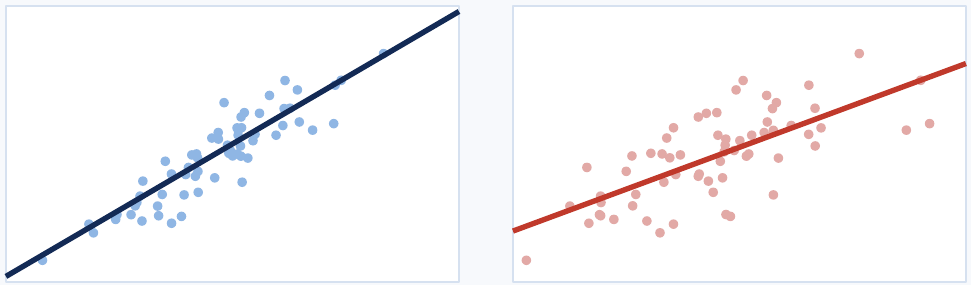
A predictor measured with error drags its own coefficient toward zero — and adherence is measured with error everywhere.
The same relationship, measured without error (left) and with error (right). Simulated at λ = 0.60, fixed seed — the fitted slope falls to 0.61.
Reliability λ
0.9
0.8
0.7
0.6
0.5
True effect ÷ published
1.11×
1.25×
1.43×
1.67×
2.00×
β_obs = λ · β_true, λ = σ²ₓ / (σ²ₓ + σ²ᵤ) < 1 always. Sensitivity, not a point estimate — no published λ exists for claims-based PDC.
Statistics room
Cite attenuation — the effect is understated.
Data-science room
Cite label noise — a lower ceiling and a bigger data bill.
Either room
The fix is a better label, not a better model.
A verified dispense raises λ on the adherence variable toward 1. That does not make a model smarter — it removes the attenuation that was hiding the effect. This holds for non-differential error; the systematic over-reporting in self-report shifts the mean and needs separate treatment.
Spearman, Am J Psychol 1904 (correction for attenuation); Carroll, Ruppert, Stefanski & Crainiceanu, Measurement Error in Nonlinear Models, 2nd ed., 2006; Frénay & Verleysen, IEEE Trans Neural Netw Learn Syst 25(5), 2014.
04.2
Healthcare AI Trains on Inferred Adherence, Not Verified
Stock photo
A fill, an opening and a memory are all inferences — a verified dose never reaches the model.
Labelled dose observations — one patient, one year, once daily
Pharmacy claims — one record per fill12
Patient self-report12
Cap sensor — an opening, not a tablet365 · 0 verified tablets
Coledy STPV — a tablet leaving the bottle365 verified
Claims record a purchase, cap sensors record an opening, apps record a memory. The valve records a tablet leaving the bottle, at a timestamp.
Classical attenuation: a predictor measured with error biases its own coefficient toward zero. Every published adherence–outcome estimate is therefore a floor, not a ceiling.
Value Every adherence model in the field trains on an estimate of the variable it is trying to predict. Coledy produces the measured value — for Coledy's models and for a partner’s.
It cannot be bought or backfilled
04.3
Predictive Value from Adherence Data
Precision dispense data fused with partners' lifelog signals is designed to train models that predict risk and generate real-world evidence.
1
Data fusion
Fuse verified pPDC with partners' lifelog data — fill the clinical-data gap with high-resolution behaviour.
2
Model development
Learn individual patterns to flag adherence drop-off risk; use adherence–biomarker correlations to predict complications.
3
AI on adherence
Analysis on measured adherence strengthens clinical development and regulatory readiness.
Not in the forecast — no data-licensing contract exists.
04.4
Digital Health Networks: Daily Social Network Engagement
Stock photo
Platforms Bring Reach; Coledy Brings a Verified Dispense Record
A scheduled, device-triggered event every day — engagement the platform does not have to manufacture.
A daily reason to open the app
A care circle worth subscribing for
Health content it can stand behind
Consent first Anything shared beyond the patient — a carer, a circle, a feed — is opt-in per recipient and revocable. Adherence is health data, not a status post.
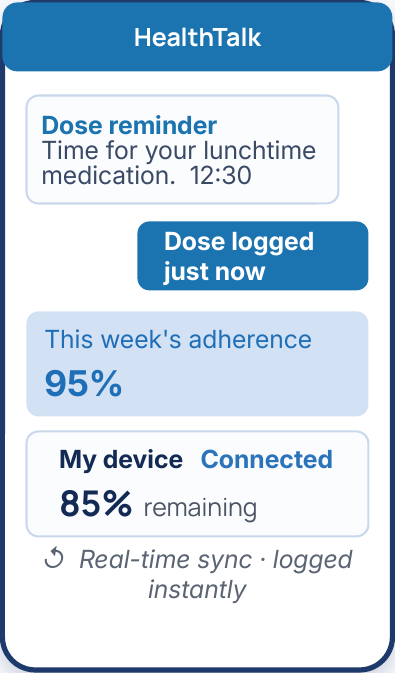
Illustrative partner-app mock — the 95% and the battery level are not measured.
04.5
Supplements Claim Efficacy With No Proof of Dosing
Four categories sold on a dosing regimen — and none can show the regimen was followed.
Blood pressure
Daily · same time
Consistent dosing maximises the reduction; irregular dosing raises cardiovascular risk.
Glucose
Twice daily · with meals
Strict pre- or post-meal timing; irregular dosing causes spikes and control failure.
Weight management
Daily · steady level
A steady blood level is required; missed doses cut the effect.
NAD+ / longevity
Daily · no gaps
Long-term use maintains levels; stopping erases the gains.
Regimens are the manufacturers' own label directions. A verified record that the regimen was dispensed is the missing half.
05
Channels
05.1
The Channel That Needs No Market Entry
An interventional trial supplies its own bottles — so the dispensing format of the country the patient lives in does not apply.
$180Bof the $300B+ a year is direct trial cash waste — Phase II/III programmes abandoned to statistical noise and adherence failure
Non-adherence inflates σ, not the effect
A subject who misses doses does not weaken the drug — they widen the variance around it. The trial then needs more subjects, or reports a false negative.
The expensive failure is finding out late
A non-adherent subject identified in week two can be replaced. The same subject identified at database lock has consumed a full arm of cost and cannot be replaced at all.
The container gate is a retail constraint
Around 85% of oral solids dispensed in Europe are blistered, and press-through packs are standard in Japan. A drug maker running a trial ships investigational supply in whatever container the protocol specifies.
The buyer is clinical development
A different budget, decision-maker and contract from the commercial channel. One signature at headquarters covers every site in the study.
Korean and Japanese drug makers are a near market
In a retail argument Korea is small. Here the contract is signed at a headquarters within reach, and the sites can be anywhere.
R&D waste figures: Tufts CSDD and Watanabe (2018). A post-authorisation study on a marketed drug is different — the patient collects an ordinary pack, so that half needs the valve-less Universal build and a bottle market. No clinical contract has been signed.
05.2
Connected-Care Infrastructure for B2B & B2G
The dose-data layer scales — from the individual to community care to smart cities.
Government (B2G)
Chronic-disease management reimbursement
Municipal (B2G)
Senior-living safety-care programmes
Payers
Value-based health-data payments
Providers
Adherence-monitoring protocols
Pharma
Clinical and RWE data services
Construction (B2B)
Healthcare wall-pad systems
Data flow: individual › community › urban infrastructure › policy. Multi-sector B2B & B2G value creation across pharma R&D, clinical data, and global platform expansion.
Illustrative — no counterparty approached.
05.3
Seven B2B Channels, and How Each One Signs
The go-to-market plan targets seven B2B channels across pharmacies, hospitals, distributors and digital platforms.
Remote and online pharmacy
Local pharmacy network
Hospital partnerships
Global partnerships
Pharma distribution
Caregiver network
Digital channels
These are target channels for the go-to-market plan. None is contracted today — Coledy intends to sell into them; it does not already operate them.
Inquiries
For licensing, partnership or investment inquiries, please write to the address for your area.