What we license, the patents behind it, what stays yours, and what has to be true before a region opens.
01
Licensing
01.1
What we license, and what stays yours
We are not selling a finished product. We license a mechanism that is proven at the part level, and you industrialise it inside your own quality system — which is the only way it can carry your name.
Proven at the mechanism level — what we bring
Child-resistance: the belt and the 58 mm closure were each certified as a separate article, under its own test programme — two job numbers, three signed certificates to 16 CFR Part 1700 from an ilac-MRA accredited laboratory (ANAB). In every case the tested configuration was the article assembled with the device.
Tablet-contact parts to USP Class VI, with Drug Master Files referenced.
Dispensing and sensing results from our own test, run to a written protocol with the pass marks fixed in advance.
Granted US and European rights in our core families run to 2040 (as of 4 Oct 2026), verified against each issuing office's own register rather than our ledger.
Product-level work — yours, by design
EMC, radio and electrical safety under your own declarations and your notified body.
Packaging and transport validation on your line, with your fill and your closure torque.
Quality management and information security certification under your existing system.
Market authorisation and registration in each territory you sell into.
A manufacturer does not want someone else's certificate. It wants a mechanism that passes in its own line — so we keep our scope at the part, and leave the product to you.
01.2
How this differs from a connected pill bottle
The release is mechanical, not actuated. There is no motor in the dispensing path, and the gate works before any electronics are added.
It works in the manufacturer's original bottle rather than moving the product to a different format.
It is licensed to the company that already makes and fills the container — not operated as a service.
01.3
Partnership Models: Three Tiers of Strategic Collaboration
Stock photo
Three ways to work together — matched to the control, capital and strategic horizon the partner wants.
1 · Technology licence
Fast entry · low risk
The partner develops and commercialises; we license the technology and IP.
IP-licensing focus
Rapid deployment
Minimal overhead
2 · Joint brand
Collaboration-led
The partner runs the business and the engineering; we transfer the technology and support the hand-over.
Joint marketing
Shared technology
Brand synergy
3 · Equity investment
Long-term platform value
Full integration with a joint development team and shared long-term upside.
Full R&D alignment
Equity partnership
Shared platform control
How to choose: control (operational leadership), investment (upfront capital and risk), strategic value (long-term synergy).
01.4
Neither Half Is Novel — the Model Is the Two Together
Device companies prove the hardware half; licensors prove the licence half; data companies prove the data half.
Company
Model
FY2024 figure
What it proves
Dexcom
Continuous glucose monitoring — integrated hardware and software
$4.03B revenue
The hardware half
ResMed
Cloud-connected sleep and respiratory care
$4.7B revenue
A scalable connected ecosystem
Qualcomm
Sells chips and separately licenses the patents behind them
Licensing $5.57B at 72% EBT · chips $33.20B at 29% EBT
Product and licence, both
Arm
Licence only, no fab
$4.01B at 97% gross margin (FYE 2025)
The licence half
IQVIA
Health data only, no device
$15.4B revenue
The data half
Compared on business model, not scale. Sources: Dexcom, ResMed, Qualcomm and IQVIA FY2024 10-K filings (segment notes); Arm Holdings annual report FYE 31 March 2025. No figure here is Coledy's calculation.
02
IP
02.1
A Category With No Incumbent, and a Granted Estate Holding the Door
Eight years of R&D since 2018 — a category with no incumbent, and a granted estate across Asia, North America and Europe holding the door.
2040Granted US and European rights in our core families run to 2040 (as of 4 Oct 2026), verified against each issuing office's own register rather than our ledger.
Beyond a device
An end-to-end platform from data capture through outcome-based reimbursement.
Precision-grade data integrity
Real-time gate sensing powers pPDC with real-world adherence data.
Behavior-native UX
Zero-effort design built on the natural dosing motion, generating longitudinal data.
High switching cost
Embedding pPDC into payer workflows creates durable lock-in.
Data network effect
Continuous accumulation of real-world adherence data improves prediction.
Registered internationally
Registered internationally — valid patents across Asia, North America and Europe. Counts and the registered proprietor of each right go with the register extracts under NDA.
02.2
The Valve Spreads the Standard; the Sensing Is What Licenses
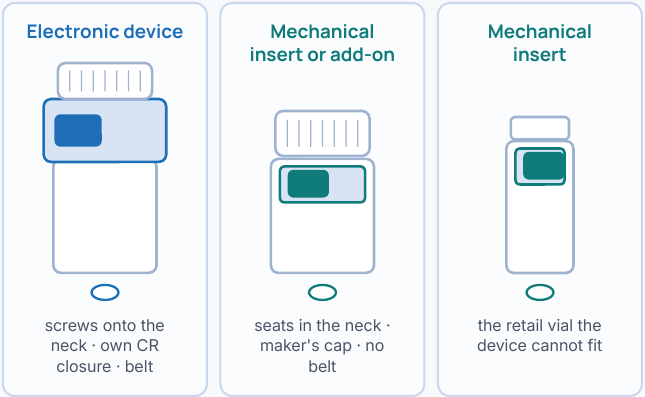
Single-tablet dispensing is mechanical. Strip the electronics and it still works — which is why the bare dispenser travels. It is not the line that earns; it is the line that makes the mechanism ordinary.
Three fittings, one mechanism.
Layer
Mechanical — not counted as revenue
Sensing — this is what licenses
What it is
A single-tablet dispensing valve, fitted as an add-on or insert — nothing else
Sensors, firmware and the dose-event record
What it needs
No PCB, no belt, no dedicated closure
The child-resistant closure and belt, certified
Where it fits
A commercial bottle under its own cap — and a retail pharmacy vial
Screws onto the neck with its own CR closure and belt
Why
A moulded part at scale bills in cents — the volume is enormous and the money is not
Not that nobody else can hold the data — whoever does is inside the estate
The estate is built the same way. Independent claims cover the passage device, the valve and the child-resistant lock standing alone, without electronics; the sensing claims put the valve inside the same independent claim. The estate does not rest on one product.
03
Licensees
03.1
Who Licenses It, and What Each One Lacks
Three kinds of counterparty, and each is missing a different thing. None of them is short of capability — they are short of one piece.
01 · Device groups
Lacks: an oral-solid route
Connected-care makers with electronics, firmware, regulatory and a field force. Every dose event they hold comes from an inhaler, a pen or a sensor — nothing reaches a tablet leaving a bottle.
Full-stack licence — royalty on their net sales
02 · App, data and platform businesses
Lacks: a verified numerator
Adherence, pharmacy and digital-therapeutic platforms that already hold the payer relationship. They compute adherence from claims or self-report — the estimate a physical dose record replaces.
Platform licence — royalty, plus a per-patient fee on verified events
03 · Regional licensees
Lacks: nothing but the rights
Distributors in a territory where the patents are granted and we have no organisation. A bottled presentation has to exist in that market first.
Territory licence — upfront, royalty and a minimum-volume commitment
Types, not a pipeline — no counterparty is named here, and none has been approached about a licence. The 28 molecules in the target portfolio are what we tooled and prioritised, not the limit of what the mechanism fits: the gate is a repeatable screen, and a licensee runs it against its own portfolio. In none of the three do we license away the patents themselves, or the definition of the metric.
Sign, tool, qualify, launch. A licence takes 12–24 months to negotiate, and only then does a mould get cut and a build get qualified. The ramp is a count of counterparties reaching launch, not a rate — which is why Year 3 has one licensee in market and Year 5 has five.
03.2
What Has to Be True Before a Region Opens
The bottleneck is not the payer. It is the container. A public payer can decide the economics work and still have nothing for the device to sit on — so the drug maker conversation comes first, and the payer conversation follows the evidence it produces.
Region
Who pays
What blocks it today
What opens it
Europe · UK
National systems, HTA per country
The pack the patient receives is a blister, and substitution changes the container
A drug maker choosing a bottle for a molecule not yet launched — a packaging decision, not a market entry
Japan
National insurance
Press-through packs are the standard oral-solid format
Interventional trials, where the trial supplies its own container
China
National procurement
Data-export rules conflict with cross-programme pooling
Revenue is possible; the dataset contribution is not
Korea
Single national payer
Small market; the value here is evidence
An evidence site — what is generated here feeds every other region
Outside the United States the payer is usually one public body — structurally a better buyer, because the same institution pays for the medicine and for the admission it prevents.
04
Data room
04.1
What Goes With the Data Room
The financial model is not on this site. It goes, with the reports behind the field results, to a named counterparty under NDA — versioned, and recorded.
Shared under NDA, on request
Financial model — five-year projections, revenue build, margin and cost structure, use of funds
Unit economics and pricing by drug group
Investment terms and licence income structure
Field validation reports — the hospital field run and the protocol test report
Dose-timing analysis from the field run, and the device logging record
Register extracts for every right, with the registered proprietor
Certificates and full CR test reports
The drug-by-drug target portfolio with sources
Inquiries
For licensing, partnership or investment inquiries, please write to the address for your area.