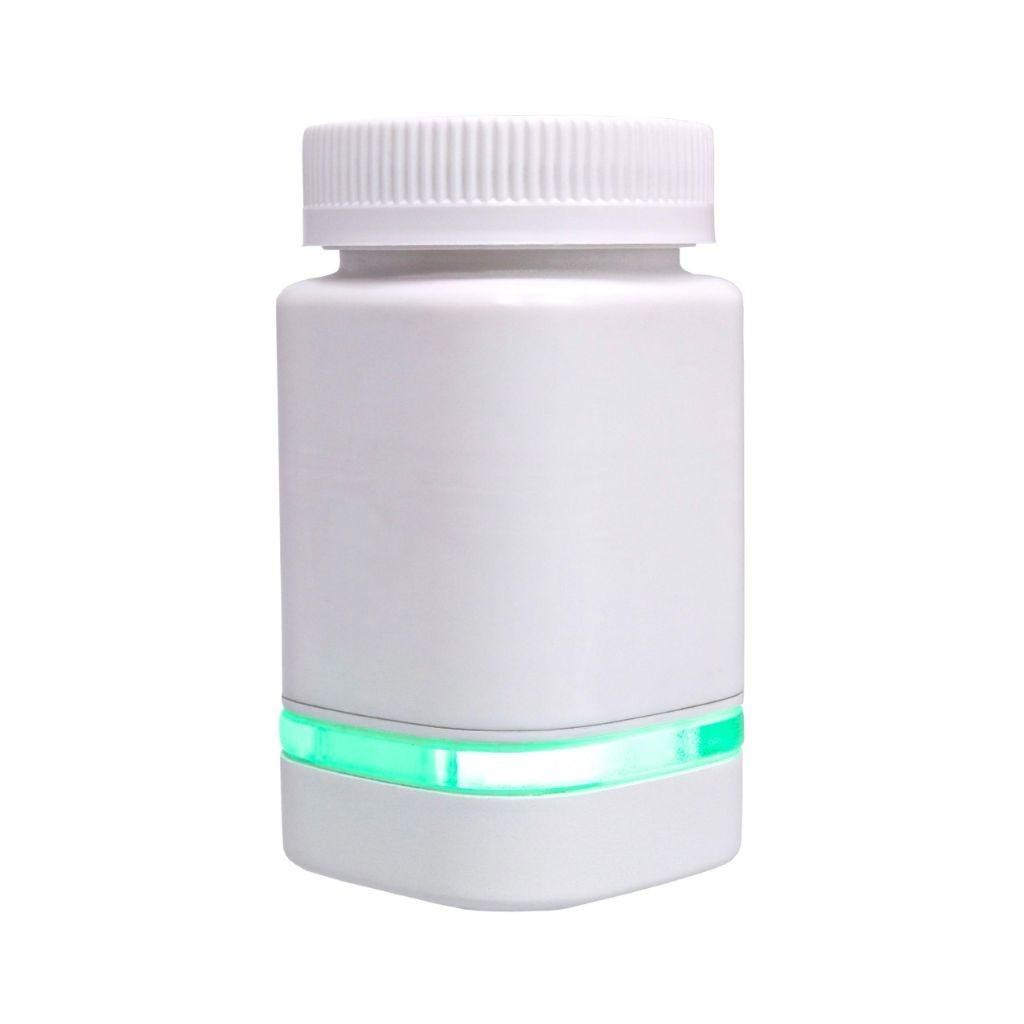
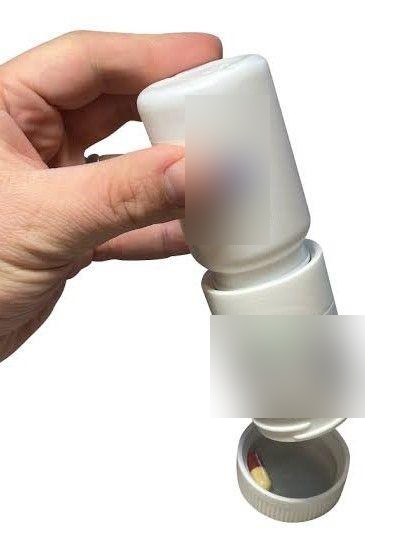
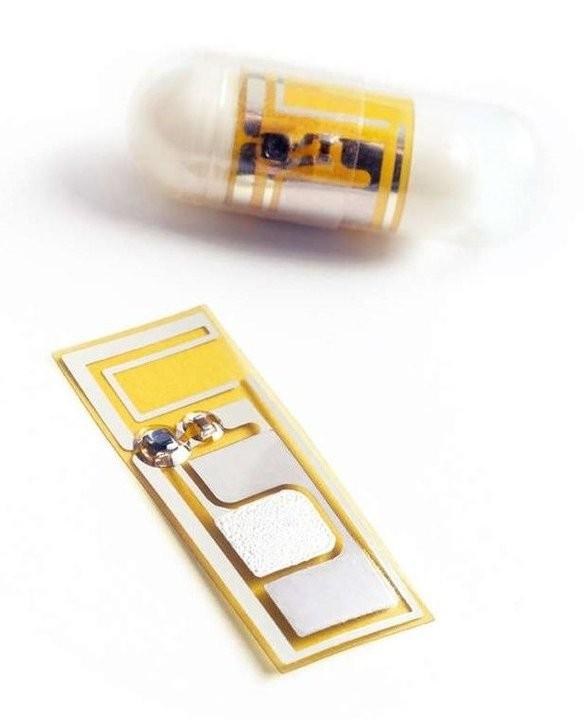
What was tested, against which standard, and what it did not show.
01
Prototype testing
01.1
Every Run Passed the Marks Set Before Testing.
409 of 410 dispensing attempts were sensed correctly — every tablet dispensed and every attempt that released nothing, bar one.
12test runs — 4 prototype devices, 8 mm and 6 mm tablets, indoor and outdoor daylight
12 of 12runs met both pass marks set before the test — dispensing ≥ 83%, sensing ≥ 96%
409/410dispensing attempts sensed correctly — tablets dispensed and attempts that released nothing alike
4 of 4devices fitted four different commercial bottles; pairing to the app was immediate
Each run emptied a commercial bottle with a desiccant sachet inside, scored at the beginning, middle and end of the bottle — 360 tablets in 410 dispensing attempts. 50 of those attempts released nothing.
Of those 50 empty attempts, not one was recorded as a dispense — including 14 in outdoor daylight, the worst case for an infrared sensor.
And what it did miss
The sensor missed 1 tablet of 360 — in one run, mid-bottle; that run still scored 97% against the 96% mark. We state it as a count: a count is checkable, and at this sample size a rate would claim more than the data supports.
01.2
Twelve Runs, Two Pass Marks, Every Run Passed
Twelve runs on four moulded prototypes, two tablet diameters, indoors and in outdoor daylight, against pass marks written down before the first run.
Mean across twelve runs, against the pass mark
Dispensing — pass mark 83%87.9%
Sensing — pass mark 96%99.8%
Dispensing ranged 83.3% to 96.8%; sensing was 100% in eleven runs and 97% in one.
Every run against both gates — eight indoor, four in outdoor daylight
8mm APass
8mm APass
8mm BPass
8mm BPass
6mm CPass
6mm CPass
6mm DPass
6mm DPass
8mm APass
8mm BPass
6mm CPass
6mm DPass
Zero stuck tablets across roughly 360 dispenses. All four devices fitted four different commercial bottles, and pairing to the app was immediate.
02
Certification
02.1
CR Certified: Belt and Closure Qualified Separately
Belt and closure certified separately — the closure on seniors first, then the packages they resecured.
Test
Panel
Result
Standard
CR belt · senior panel
100 adults aged 50–70
95% — 5 failures (≥ 90% required)
Meets 16 CFR Part 1700
CR belt · child panel
50 children · belt on the device
96% — 2 openings in 10 min; 98% at 5 min (≥ 90% required)
Meets 16 CFR Part 1700
Closure · senior, then child
100 seniors → 98 packages → 98 children
Seniors 98% · 93 of 98 children could not open it — 5 openings vs 19.6 allowed
Meets 16 CFR Part 1700
Two years of development and certification went into the CR belt — Coledy’s own patented locking article. It is what holds the device to a bottle it was not made for, and it is certified on its own senior and child panels. The closure is an established design: the cap threads onto a polycarbonate device body, not an HDPE neck.
Two certificates, one device
The CR closure and the CR belt were each certified as a separate article, both tested on the connected device. A new container or bottle shape is re-certified; we share the method and our test experience.
Certificates and full test reports are shared in the data room.
Belt panels ran Sept–Dec 2024; the cap was applied at 8 inch-pounds, rested 72 hours, and tested Oct 2024 – Jan 2025. Tested and certified at an ilac-MRA accredited laboratory (ANAB). Full reports on request.
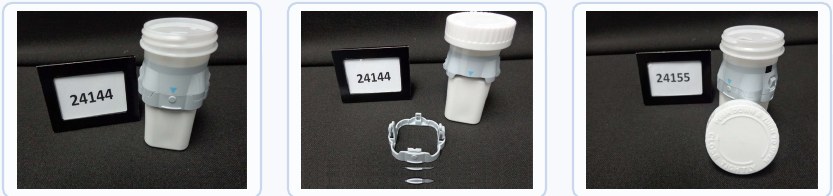
Test articles as presented — job 24144 (belt with device; belt removed) and job 24155 (closure with instructions).
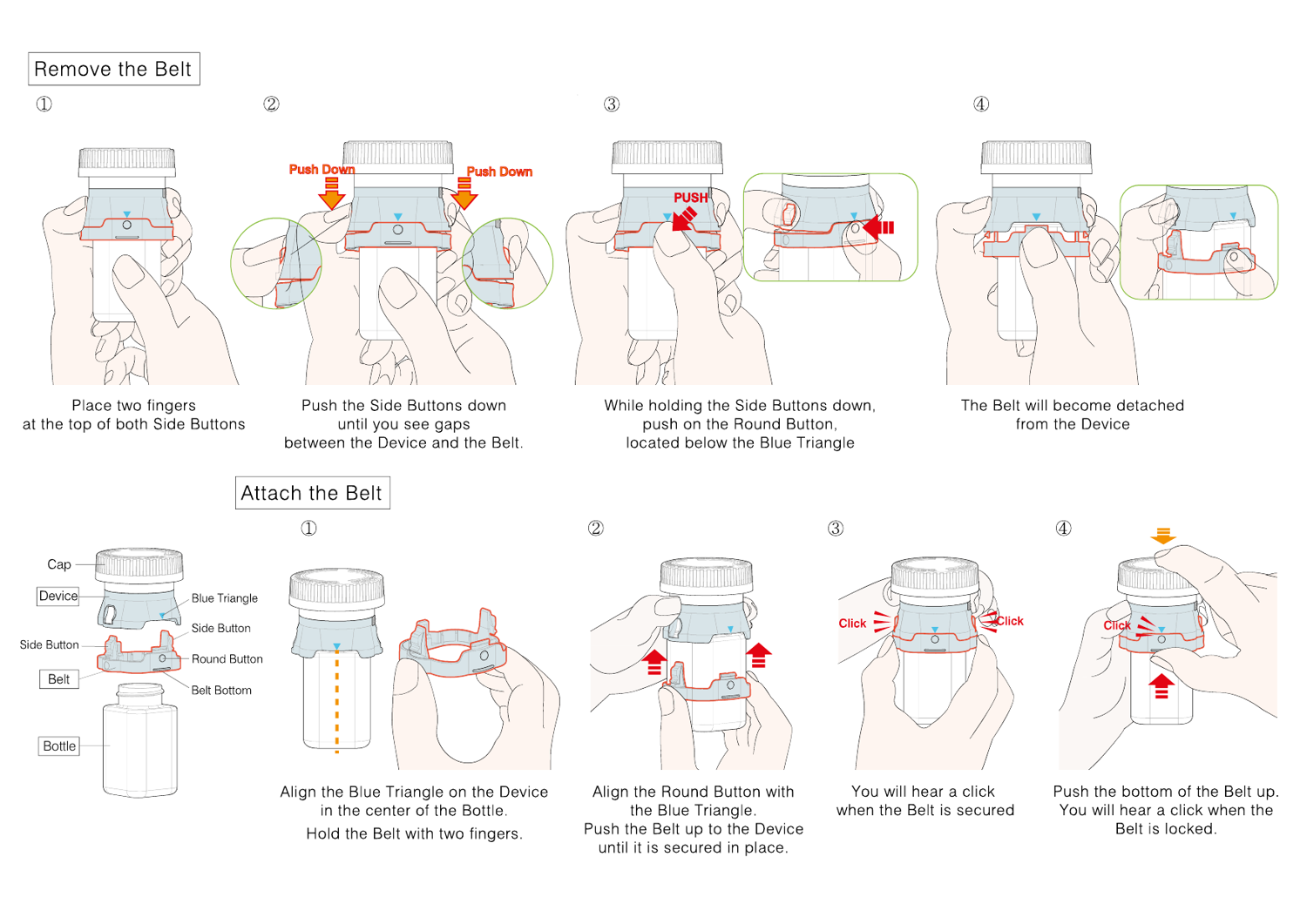
CR belt manual — the test articles' instructions
1
Remove: place two fingers on top of both side buttons and push them down until gaps appear
2
While holding them down, push the round button below the blue triangle — the belt detaches
3
Attach: align the blue triangle on the device with the centre of the bottle
4
Align the round button with the triangle and push the belt up — it clicks when secured
5
Push the bottom of the belt up — a second click when it locks
CR belt manual, as supplied with the test articles.
02.2
Pharma-Grade Certified Materials
Three material contact tiers — USP Class VI and 21 CFR 177.1520, ISO 10993, UL94.
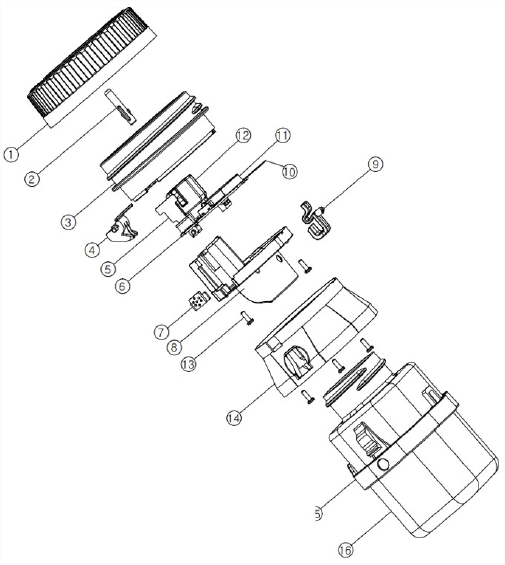
Device assembly · 16 parts · callout numbers referenced in the table
6tablet-contact parts · 2 polymer systems · both referenced to a Drug Master File
Contact tier
Parts (callout) · material
Qualification
Tablet contact
Valve (4) · dispenser (8) · dispenser cover (3) · top button (2) · cap outer + inner (1) — PC ML-1020R · PP J801
USP Class VI · FDA 21 CFR 177.1520 · DMF 032590 (Type III) + DMF 21499 · ISO 10993
Hand contact
Belt (15) · dispenser holder (14) · pair button (7) · battery pull tab (10) — PC ML-1020R · ABS AF365 · PET
USP Class VI · FDA 21 CFR 177.1520 · ISO 10993 on PC parts · UL94 V2 / V1
Enclosed — no contact
IR cover front + rear (12) · main PCB (6) · sub PCB TX / RX (5) · screw (13) — ABS AF365 · FR4 · SWCH18A
UL94 V0 on PCB · UL94 V1 · RoHS
Across the full bill of materials RoHS · CONEG · ISO 9001 · UL94 rated on every polymer part
Bill of materials. DMF numbers are the resin suppliers' Drug Master File references.
03
Sensing
03.1
Tablet-Level Evidence, Without Ingestion, Video or a Motor
Nothing is swallowed and nothing enters the body — the device stays on the bottle, which is what holds the per-patient price at population scale.
Approach
How it works
What the user does
Technical profile
Single tablet
Gate-valve sensor (Coledy)
Gate valve + sensor verify one tablet
Open and tilt
Add-on · one-year single-use battery
Yes — physically verified
Smart cap bottle
Cap open / close
Open and tilt
Electronic bottle
No — an opening
Motorized dispenser
A motor releases one tablet
Open, press the motor button, tilt
Add-on · motor-driven
Yes — actuated
Ingestible sensor
Activated in the stomach
Open and ingest
Sensor is swallowed · wearable / hub
Yes — inside the body
Vision AI
Ingestion inferred from video
Record a video
Video recording · privacy concerns
Inferred
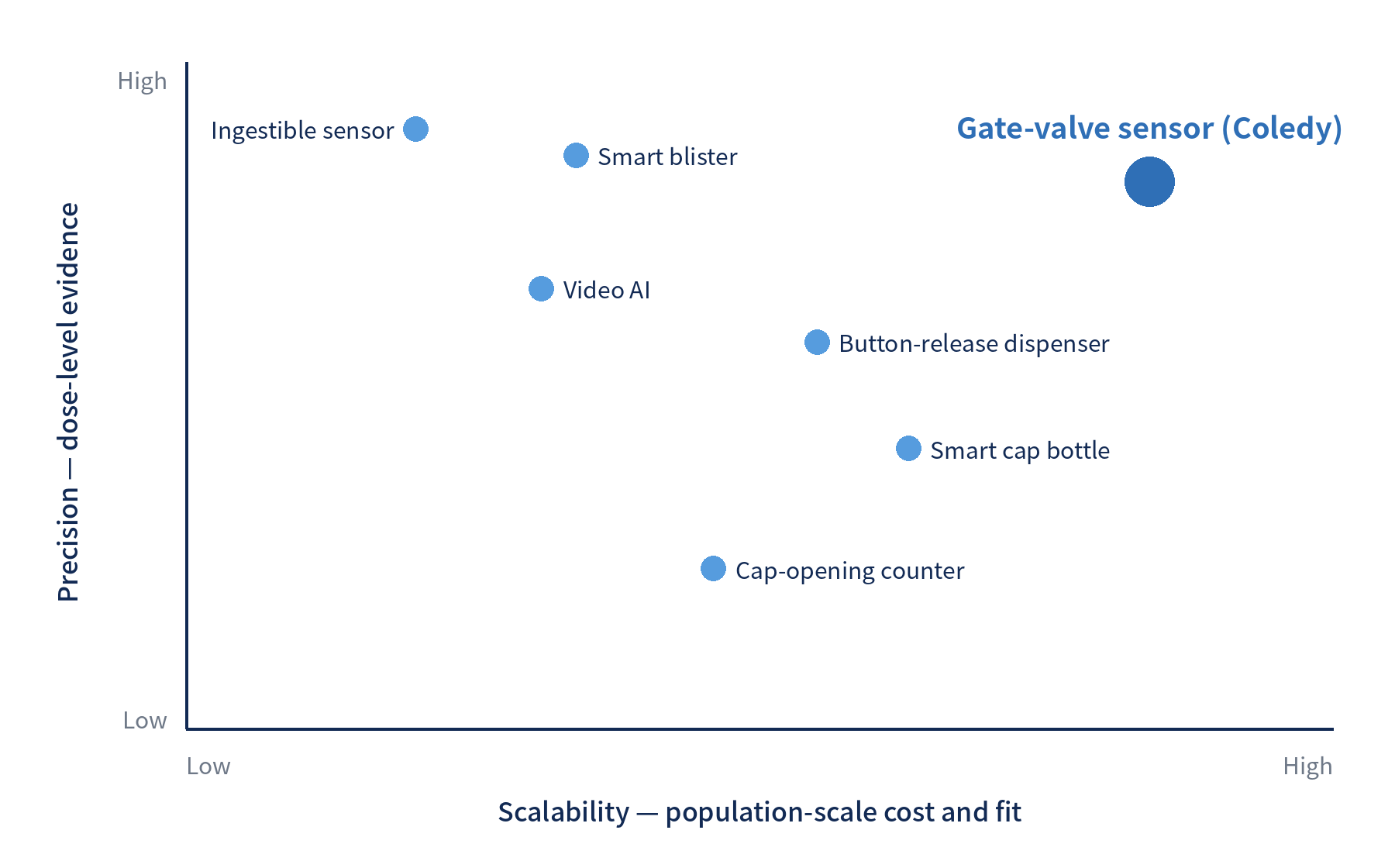
Positioning by technology.
Payer reimbursement utility
Technology — why
High
Gate-valve sensor (Coledy) — each dose verified; pPDC is quantified
Medium
Motorized dispenser — dose-level, but motor-driven with an extra action per dose
Low
Cap-opening counter · video AI — intake is inferred, not verified
Positioning is illustrative; several peers are also potential integration partners.
03.2
The Sensor Moved Into the Blister. The Argument Did Not Change.
Smart blisters count a tablet as well as we do. What differs is who has to agree before a patient gets one, and what happens at the next refill.
Smart blister
Smart bottle
Add-on (Coledy)
What has to change
The product itself
The dispensing step
Nothing
Who decides
The marketing-authorisation holder — sensors are built in at manufacture, product by product, line by line
The pharmacy — the medicine has to be moved into it, and some labels instruct dispensing in the original container
The payer and the patient — it seats on the finished bottle; the closure is replaced, the medicine is never moved
Consumable or asset
Bought again with every pack
—
Bought once, runs to the next replacement
Across refills
Ends when the pack ends — a twelve-month record has to be stitched across packs
—
Crosses refills
And the drift is against us — we say it first. Blister packaging is growing on both sides of the Atlantic, regulators favour unit-dose formats, and unit-dose blisters dominate developing markets on price. None of that is a reason a bottle add-on loses; it is the reason we lead with the bottle route and treat the rest as upside.
Sources: packaging trade press and market reports on smart-blister economics and regional format share.
04
Field results
04.1
Where Adherence Drifts, Visible Only Dose by Dose
Same drug, same protocol, the same months — each dot is one verified dispense, plotted at the hour it left the bottle.
Tight · Device 01
Jun 2022 – Oct 2023. Seventeen months at nearly the same hour — a series this regular is itself a signal.
Drifting · Device 02
Jun 2022 – Oct 2023. Dispensed every day, but the hour wanders across the working day and back.
Scattered · Device 03
Jul 2022 – Aug 2023. Same pills, no pattern — and the record thins where the others stay dense.
All three look adherent to a refill record, a pill count or PDC. The hour of each dose exists only because a device recorded it.
Real patients, not a simulation — one once-daily HIV medicine, a cohort at a major university hospital, June 2022 to October 2023. Vertical axis: time of day.
04.2
No Dose Record Lost, 17 Months on One Battery
Patients with HIV used the device in daily life, June 2022 to October 2023 — logging spans read from our own management platform.
Logging span per patient, months
Patient 0117 mo
Patient 0217 mo
Patient 0317 mo
Patient 0414 mo
Patient 0514 mo
Patient 0613 mo
Patient 0712 mo
Patients who used the device for a year or more. Shorter spans ended when patients stopped using it, not when the battery ran out.
17 molongest span recorded, on a single-use cell
7patients logged a year or more on the original cell
No dose record was lost
The device stores events locally and backfills them the next time the app connects.
Sized between a cap and a dispenser
Larger than a cap-only sensor, far smaller than any motorised unit, and usable in the field. The shorter 75 cc bottle is now supplied — the length complaints were about the bottle.
Single-tablet dispensing verified
Early builds could release more than one tablet in a single event. The tooled valve since: zero stuck tablets across ~360 dispenses, 99.8% sensing.
IRB-approved single-centre study at a major university hospital. The trial drug was an elongated tablet on a larger bottle — the large-opening valve build.
Inquiries
For licensing, partnership or investment inquiries, please write to the address for your area.